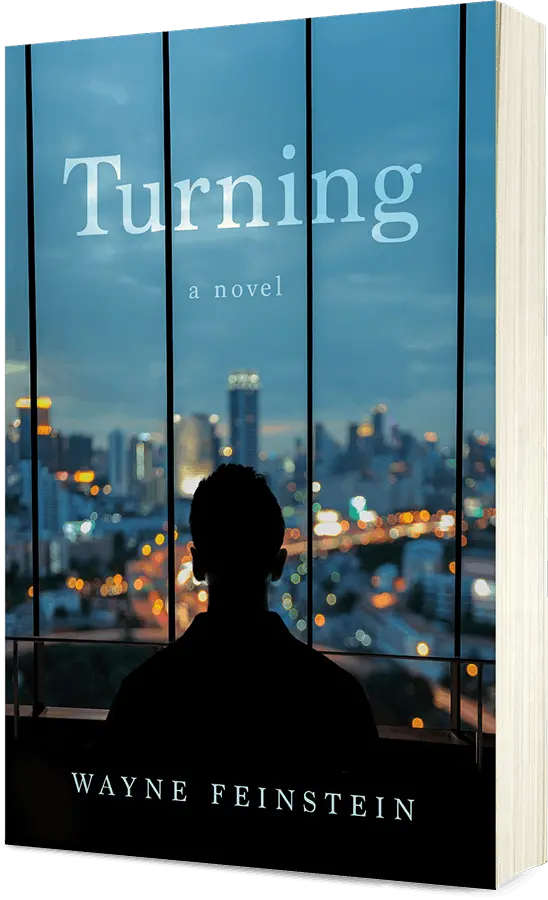

Turning

Can a lifetime of wrongs be made right?

A powerful novel about ambition, regret, and the cost of emotional absence.

About The Book

By almost every measure, Joe Fredericks, a real estate developer in New York City, is at the top. Successful, wealthy, and now the biggest developer in New York, he should feel as strong and solid as a Manhattan skyscraper. But one phone call from his ex-wife and that façade shatters. His college-age son, Steven, is dying of cancer and has forbidden Joe from visiting him in his final days.

Steven’s death exposes how hollow Joe’s life really is. While trying to move forward, Joe can’t help but reflect on his past as waves of memories resurface. As he relives the pivotal moments of his life, can Joe determine what went wrong in time to save his strained relationship with his daughter and Steven’s twin, Laura? And can looking at his life in a new light help Joe find his future path in his career and in love?

TURNING is available everywhere books are sold on June 9, 2026

ABOUT THE AUTHOR

Born in Albany, New York, Wayne Feinstein grew up in Columbus, Ohio. A graduate of Colgate University, he earned graduate degrees in Jewish Studies at Hebrew Union College and certificates in social work and financial planning at UC Berkeley. He enjoyed two successful careers, first in Jewish community service, including eighteen years as the CEO of three large Jewish Federations in Detroit, Los Angeles, and San Francisco. In 2001, Wayne changed careers and became a financial adviser for Capital Group Companies in the Private Wealth group, from which he retired after nearly nineteen years at the end of 2019. In retirement, Wayne has dedicated himself to writing a blog on Substack, “I Try to Get This Off My Chest” and writing fiction, and has written three novels and a growing number of short stories. Turning is his first novel to be published.

Praise For Turning

INDUSTRY REVIEWS

How could I have been so obtuse, so neglectful that my dying son hated me until the end?” For Joe Fredericks, the protagonist of Wayne Feinstein’s novel, Turning, it took little effort to be such a sleazeball. Joe is the definition of success in one sense of the word. He’s rich, affluent, and rubs elbows with the movers and shakers of NYC. He’s also a shallow man with little understanding of what’s truly important in life. After a call from his ex-wife, Molly, Joe learns his young son Steven is dying within days. To make matters worse, Steven explicitly forbids Joe from seeing him before he passes away. As life finally slaps Joe in the face, he awakens to the fact that somewhere along the way, he screwed up royally. Fearful of losing his daughter as well, Joe undertakes a journey of the soul as he tries to understand what went wrong, only to discover that while you may be able to win the rat-race in life, all it really means is that you’re a bigger rat.
Uncomfortable yet poignant, and starting with a gut-punch, Turning by Wayne Feinstein is an emotionally resonant example of contemporary fiction. The plot centers on a gifted Jewish man who somehow forgot what it means to be a good family man and his struggles to cope with the aftermath. Throughout the narrative, numerous themes, including consequences and redemption, define the story and create a relatable tale. Character development is top-notch, but I want to focus on Joe because I know men like him. If it were possible to reach into the pages and strangle him, I would have done it. This guy is very realistic and made me wonder if the author based him on a real-life person. The pace is easy-going and matches the concise writing style well, making the novel both a believable tale and a warning to those who forget that riches mean little when your own family despises you.

On the surface, Joe Fredericks’s life is going exceptionally well. He’s a major player in New York City’s real estate development market, has a stable relationship with Margo, the dynamic CEO of Brickson Pharmaceuticals, and has all the trappings of worldly success at his fingertips. But when his ex-wife Molly calls with the news that their son Steven is dying of cancer, Joe’s world comes to a crashing halt. Steven and his twin sister Laura want nothing to do with their long-absent father, forcing Joe to confront what kind of parent he’s been, how his own childhood wounds impacted his fathering, and whether he can create a more meaningful and connected life with his loved ones.

Feinstein pens a moving debut that explores parenthood, family dynamics after divorce, and the arduous work of balancing career success with family life. Joe is a flawed character who, when it comes to being a father, makes plenty of mistakes. His reckoning happens through flashbacks of his past—the missteps, failures, and moments of possible change passing him by—that show his ambitious pursuit of wealth and entanglement with mafia-controlled unions, dangerous women, and political corruption. His awakening, when it comes, is more introspective than glaring, playing out in a creeping awareness that true change will never come by repeating the sins of the past.

As Feinstein has Joe analyze his past and his future, growth and healing slowly occur, alongside a realistic picture of how difficult it can be to change old habits. As Joe grieves Steven’s death, he’s also given the opportunity for a new beginning with Laura, though the path to their reunion is not easy—and comes with more unexpected loss. The narrative gets bogged down at times in the details of Joe’s lavish lifestyle, but his ultimate realization—that it’s “never too late to change… to engage in acts of redemption toward a better future

—is compelling
Takeaway: Moving narrative of grieving father reflecting on his past mistakes

A remorseful, success-driven man confronts the emotional wreckage of his life after losing a child.

In the early 2000s, real estate developer Joe Fredericks has the markers of success—money, power, influence—but with none of the personal satisfaction. After cutting off all contact with his ex-wife and teenage fraternal twin children, he assumed he would have all the time in the world to make amends for being an absent father. Then he gets the news that his 21-year-old son, Steven, has stage 4stomach cancer. When Joe tries to visit him in the hospital, the staff informs him that he’s not on the list of people allowed to see him in his final days. Steven’s death follows shortly thereafter; at the funeral, Joe sees his daughter, Laura. The novel then shifts its focus to chronicle Joe’s attempts to reconcile with his only remaining child. Readers follow the protagonist’s recollections as he takes time away from work to reflect on what led him to this current moment—his failure as a husband and father. The narrative hearkens back to when he met his wife in college and continues through their marriage, their careers, and their eventual divorce. It’s a familiar but effective narrative structure, with each memory adding weight to the protagonist’s eventual realization that his success came at the expense of human connection. Feinstein doesn’t gloss over Joe’s significant faults, and the result is a character who’s hard to like but compelling to follow—one whose reckoning with past mistakes feels earned. The dialogue, however, can feel stiff at times, with conversations sounding more like statements of theme than natural speech: “What childhood experience could you have had that justified abandoning Steven and me?” The prose is clean and direct, however, which lends an authenticity to the narration. The pacing mirrors Joe’s internal process, which can drag occasionally but resolves itself in a satisfying way.

An uneven but often engaging character-driven meditation on regret and redemption.

GET IN TOUCH